|


Market Analysis
Weekly Macro Brief: Inflation Surprise, Policy Crossroads, and Geopolitical Tensions
Oct 27, 2025
share_this_article


back_to_articles
1. Key Takeaways
- US CPI (September) rose 0.3% m/m and 3.0% y/y, both below consensus (0.4% / 3.1%).
- Core CPI advanced 0.2% m/m and 3.0% y/y, marking the softest pace since early 2024.
- The softer print reinforces expectations of a 25 bps Fed rate cut at the October FOMC (probability: 98% per CME FedWatch).
- Gold and silver corrected after record highs as profit-taking emerged.
- Trump re-ignited trade tensions terminating Canada talks and hinting at new 10% tariffs, while US–China negotiations hinge on next week’s Xi–Trump summit in South Korea.
- The “Magnificent Seven” tech earnings week begins, testing whether markets can sustain their AI-led rally amid stretched valuation.
2. Inflation Data: Softer Reading Amid Fragile Conditions
The long-delayed September CPI provided the market’s first official data since the three-week US government shutdown. Despite limited staffing at the Bureau of Labor Statistics, the release confirmed a moderate easing in price pressures.
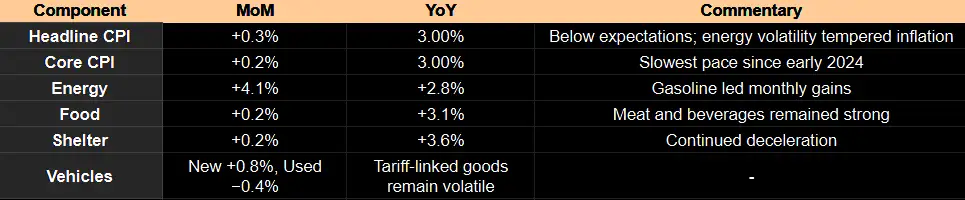
The data confirmed disinflation without contraction, easing fears of renewed overheating despite Trump’s tariff rhetoric.
“This report will clearly keep the Fed on track to cut rates next week,” noted Art Hogan, Chief Market Strategist at B. Riley Wealth, emphasizing the Fed’s pivot toward employment stabilization over inflation vigilance.
3. Federal Reserve Policy Outlook
- The FOMC meets next week with markets fully pricing a 25 bps cut to the 4.00–4.25% band.
- Futures indicate a further 25 bps cut in December, with >90% probability.
- Chair Powell has reiterated that current rates are “sufficiently restrictive”, with future decisions data-dependent.
- BlackRock’s Kristy Akullian summarized: “The bias is still toward easing, not tightening
4.Precious Metals: From Euphoria to Correction
After historic highs, gold and silver saw broad profit-taking:
- Gold retreated over 2% from record levels.
- Silver mirrored the pullback amid fading safe-haven demand.
The shift from “inflation anxiety” to “data relief” drove short-term liquidation, though long-term bullish fundamentals monetary easing, political uncertainty, and reserve diversification remain intact.
5. Geopolitical Flashpoints: Trade Frictions Return
- Trump ended trade talks with Canada, retaliating against an Ontario-funded ad quoting Ronald Reagan’s 1987 free-trade remarks.
- The White House signaled a 10% tariff increase on Canadian imports “above current levels.”
- In parallel, US–China tensions are re-emerging ahead of the Xi–Trump summit in South Korea:
- Washington mulls software export curbs after Beijing restricted rare-earth exports.
- The USTR is reassessing China’s compliance with Phase One commitments.
Market implications:
- Renewed tariffs risk re-inflating goods prices by Q4.
- Multinationals in autos, semiconductors, and materials face heightened supply-chain uncertainty.
- Any escalation could challenge the Fed’s disinflation narrative entering 2026.
6. Corporate Earnings: The “Magnificent Seven” Under the Microscope
The coming week features five of the “Magnificent Seven” mega-caps Microsoft, Alphabet, Meta, Apple, and Amazon reporting Q3 results.
- Tesla’s miss last week set a cautious tone, with EPS of $0.50 vs $0.54 expected, despite record Q3 revenue.
- The group’s performance will test whether AI-driven optimism remains justified, amid fears of valuation excess.
“We’re at a critical juncture,” said Victoria Scholar of Interactive Investor. “If AI spending doesn’t translate into profit growth, the correction could broaden.”
We will release a separate email briefing this week dedicated to the full earnings expectations, consensus metrics, and market scenarios for these key companies.
7. Market Outlook: A Calm Before the Storm
Rates: Treasury yields softened post-CPI as rate-cut odds firmed.
FX: The USD eased, reflecting dovish repricing.
Equities: The Nasdaq 100 extended gains, but durability hinges on corporate guidance.
Commodities: Oil remains volatile amid geopolitical and OPEC+ developments.
Strategic View (Summary):
- Fed: 25 bps October cut fully priced; December likely.
- Inflation: Moderating but tariff-sensitive.
- Equities: Earnings and AI sustainability under scrutiny.
- Risks: Data reliability, tariff escalation, global demand slowdown.
8. Conclusion: Between Relief and Reality
The September CPI offered a much-needed reprieve from inflation anxiety, anchoring expectations for imminent Fed easing.
Yet, the policy comfort is fragile. Tariffs, trade fragmentation, and lingering data distortions suggest that disinflation may prove uneven.
As the Fed prepares to cut rates, the broader macro environment remains defined by geopolitical uncertainty and valuation risk.
In this landscape, selectivity and risk control will be the key determinants of portfolio performance through Q4 and into 2026.
Yet, the policy comfort is fragile. Tariffs, trade fragmentation, and lingering data distortions suggest that disinflation may prove uneven.
As the Fed prepares to cut rates, the broader macro environment remains defined by geopolitical uncertainty and valuation risk.
In this landscape, selectivity and risk control will be the key determinants of portfolio performance through Q4 and into 2026.