
Market Analysis
FOMC Preview: Warsh’s First Fed Meeting Could Redefine Monetary Policy
Jun 17, 2026
share_this_article


back_to_articles
Markets Await the First Major Policy Test Under New Fed Chair Kevin Warsh
The Federal Reserve is widely expected to leave interest rates unchanged at 3.50%–3.75% at today's FOMC meeting. However, the real focus is not the rate decision itself—it is how new Chair Kevin Warsh intends to reshape the Federal Reserve's communication strategy, inflation framework, and policy outlook.
With inflation running near 4.2%, driven largely by energy prices following the Iran conflict, and labor market conditions remaining resilient, investors are increasingly questioning whether the next move from the Fed will be a rate cut—or even a rate hike.
What Markets Expect
The overwhelming consensus is:
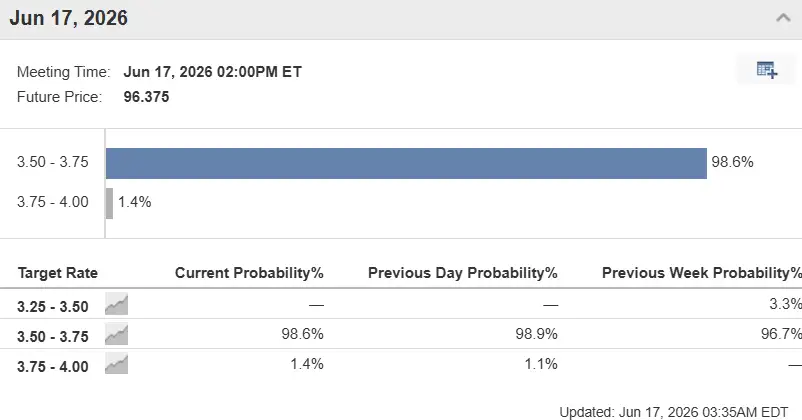
- No rate change
- Federal Funds Rate remains at 3.50%–3.75%
- Fed remains in a wait-and-see mode
- Focus shifts toward future policy guidance
Fed Funds futures currently imply almost no chance of a move at this meeting, while markets are increasingly pricing the possibility of a rate hike later this year.
The Biggest Story: Kevin Warsh's Communication Revolution
Warsh has repeatedly criticized:
- Excessive Fed communication
- Forward guidance
- The Summary of Economic Projections (SEP)
- The Dot Plot
His view is simple:
- The Fed should make decisions meeting-by-meeting instead of committing itself to future policy paths.
Warsh believes the Fed became trapped by its own forecasts during the inflation surge of 2021–2022, contributing to policy mistakes and delayed responses.
This meeting could be the first step toward a more discretionary and less predictable Federal Reserve.
The Dot Plot Drama
One of the most closely watched questions:
Will Kevin Warsh submit a Dot Plot projection?
Many economists believe he may refuse.
Possible outcomes:
Scenario 1: Full Participation
Warsh submits a dot normally.
Market Impact
- Minimal disruption
- Seen as policy continuity
- Keeps current communication framework intact
Scenario 2: Soft Rejection
Warsh submits a dot but emphasizes:
"The dots are not a forecast and not a policy commitment."
Market Impact
- Slight reduction in the importance of future dot plots
- Moderate volatility
Scenario 3: Hard Rejection
Warsh refuses to submit a dot and questions the usefulness of the tool.
Market Impact
- Major communication shock
- Increased uncertainty
- Potentially higher market volatility
- Larger reactions to future economic data
This is currently viewed as a realistic possibility by several Wall Street economists.
Fed Independence Under the Spotlight
Warsh is also expected to face questions regarding President Trump's preference for lower interest rates.
Markets will closely monitor whether Warsh:
- Explicitly defends Fed independence
- Emphasizes price stability over politics
- Signals willingness to maintain restrictive policy despite political pressure
A strong defense of independence would likely:
- Support the U.S. dollar
- Push Treasury yields higher
- Pressure equities in the short term
A softer response could have the opposite effect.
Bottom Line
This FOMC meeting is unlikely to change interest rates, but it could fundamentally change how markets interpret the Federal Reserve.
Kevin Warsh's first appearance as Chair is less about today's policy decision and more about establishing a new regime. Investors will be watching for signs that the Fed is moving away from the Powell era of heavy forward guidance toward a more discretionary, data-dependent approach.
The rate decision itself is expected to be uneventful. The press conference may be one of the most important Fed communications events of the year.
related_articles
Market Analysis
Dollar Slammed as Payrolls Unexpectedly Shrink in July
Aug 7, 2026
Market Analysis
Wall Street Earnings Preview: Banks Take Center Stage as Investors Search for Clues on Growth, Rates, and Market Direction
Jul 13, 2026

Market Analysis
Markets Focus on Inflation Outlook and Central Bank Signals
Jun 24, 2026